The Beef Bribe: A Ninety-Day Discount That Expires When the Votes Get Counted

Updated: Aug 30

A supplement to Big Sarge Economy Watch — Vol. 1 Issue 7 (Monday).
“The test of our progress is not whether we add more to the abundance of those who have much; it is whether we provide enough for those who have too little.”
Franklin D. Roosevelt, Second Inaugural Address, January 20, 1937
There’s a man in the Publix on Coral Way doing arithmetic in front of the meat case. The ground beef sits at $6.89 a pound. That’s the July 2026 national average for 100% ground beef, up 10.1 % from a year earlier. He doesn’t need a trade theory. He needs the number to come down, and on Friday morning the President of the United States told him it would.
Roosevelt said his line in the cold rain in January 1937, to a country where millions of Americans had too little of everything. He wasn’t handing out a slogan. He was handing out a measuring stick, and the stick had a blade on it: don’t tell me what you announced, tell me who ate.
So let’s measure. What the man in Publix got was an announcement that up to 300,000 metric tons of imported beef would move past the out-of-quota tariff for ninety days, at a 25% discount the White House says it already negotiated with foreign exporters. The executive order making any of it really hasn’t been signed. The White House says that comes within the next two weeks. And the product isn’t hamburger in a family-size tray. It’s lean beef trimmings for ground beef production, grinder feedstock, an industrial input gets blended, packed, trucked, and shelves before anybody reads a price tag.
Now do the calendar. Election Day is November 3. The announcement came August 21. That’s seventy-four days. The waiver runs ninety. Relief lands before the election and expires after it. A campaign advertisement wrapped in butcher paper.
Here’s the number the announcement skipped. Beef and veal ran 9.4% above a year ago through July, while the meats, poultry, fish, and eggs category moved 1.9%. Beef isn’t riding food inflation. It’s outrunning the rest of the meat case, and tariffs have nothing to do with why. On January 1 there were 86.2 million cattle and calves in this country, the smallest herd since 1951. Years of drought, high feed costs, expensive credit, herd liquidation, and New World screwworm pressure along the Mexican border left ranchers with fewer animals just as demand stayed high. Washington has announced a phased reopening of select southern ports. None of that puts a cow on the ground this quarter. You can’t tariff your way into an animal that was never born.
The ranchers said so before lunch. Colin Woodall, chief executive of the National Cattlemen’s Beef Association, said the announcement and “other market interventions throw cold water on the prospect of herd expansion and sacrifice long-term stability for short term messaging.” He kept going: “flooding the market with government-subsidized, below-market beef is not the way to rebuild the American cattle herd.” That’s one of the most reliably Republican industries in America, watching this administration kneecap the one thing it had going.
I don’t know what the White House’s private polling says. I know what the public polling says. The economy is the top issue for 37 % of voters, and Democrats hold an eight-point lead on the congressional ballot. When the number that decides an election is a grocery number, you don’t fix the herd. You fix the number, and you fix it for ninety days.
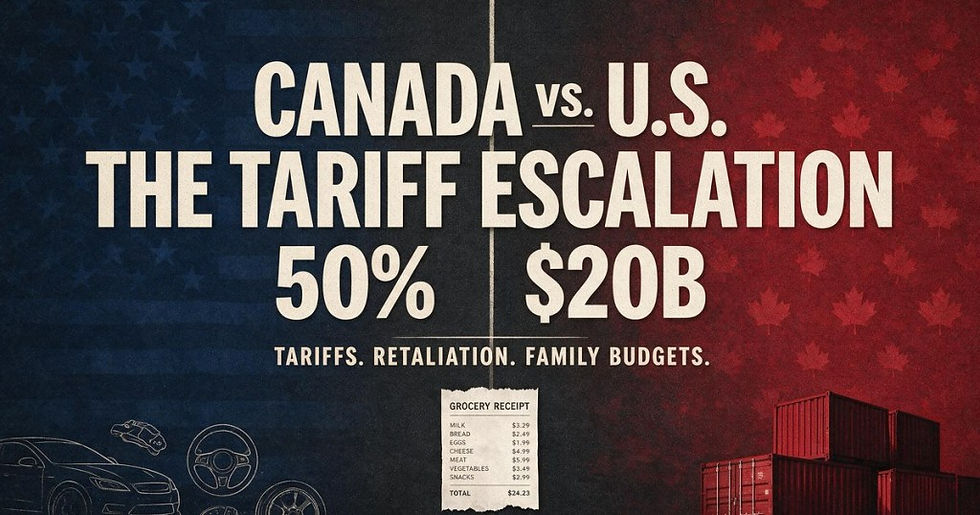
Now Canada. Trade talks collapsed Friday night, and the 50 % US tariffs on roughly $20 billion in Canadian goods took effect at midnight. Prime Minister Mark Carney said Canada would retaliate with tariffs of its own beginning September 8. Federal Reserve researchers found tariffs implemented through November 2025 had already raised core goods prices 3.1% through February 2026 and that pass-through was “effectively complete.” This inflation effects have since stabilized at lower effective tariff rates. Fine. Stabilized at the top is still the top. Whatever this waiver eventually saves on ground beef, another aisle can take back.
Here’s what I keep chewing on. The man doing arithmetic at the meat case and the rancher rebuilding a herd got played by the same announcement, in opposite directions, on the same morning. One got a temporary promise on an industrial input. The other got a market signal that says the second your margin looks good on television, Washington will find a waiver to fix it. Apply Roosevelt’s test to that, and you have your answer in about four seconds.
An independent read on the national economy and the working American. Founded and written by Wayne Ince. Miami, Florida.


Comments